


Industries
Auto Repair Shop Financing
An auto repair shop's revenue is measured in bays and hours — and bays need hoists, alignment machines and diagnostics to earn. Makwa Path helps Canadian shops explore financing for the equipment and growth that turn booked-out demand into revenue.
Last reviewed September 22, 2026 · Makwa Path Financial · Indigenous-owned · Canada-wide
What financing might an auto repair shop use?
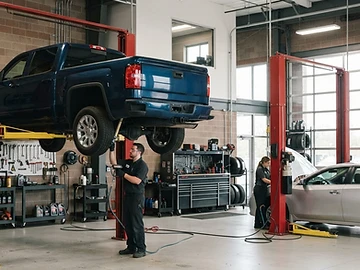
Mostly equipment and expansion financing: vehicle hoists and lifts, wheel alignment systems, diagnostic platforms, compressors and tire equipment, shop tooling, additional bays and shop space, and working capital where eligible. Because a bay without equipment earns nothing, equipment financing is usually the heart of the review. Approval and lender criteria apply.
What shops typically finance
The mix shifts with the shop's stage:
- Opening — a first hoist, starter diagnostics, a compressor, and the tooling of the trade
- Growing — additional hoists, an alignment rack, tire equipment for a second service line
- Booked out — a fourth bay, a second lift, or the diagnostic platform that unlocks dealer-level work
- Replacing — an aging hoist past safe service, a compressor that finally quit
The bay math
Shop equipment has the clearest productivity math of almost any trade: a bay without a hoist earns nothing; a bay with one books out. When a shop is turning work away, the payment on the equipment that captures the waiting work is compared against the revenue it unlocks — on the shop's real numbers, not a brochure's.
New shop or bought shop
Two paths into ownership. Opening a fresh shop is a startup review — the plan, the location, the tools, the lined-up work. Buying an existing shop (its bays, its equipment, its customer base) is an acquisition review — the business's numbers, your contribution, the transition. Both are explored honestly, and which one fits is part of the conversation.
Service lines that change the math
Adding a tire line, an alignment rack or a specialty (diesel, performance, EV-ready service) changes what the shop can book — and what equipment list makes sense. Those expansions are reviewed against the demand the new line will realistically bring, not enthusiasm.
How the review works
Start with the shop's situation — opening, booked out, replacing, or adding a line. The review sizes the equipment to real volume, then lays out financing or leasing options with payment, term, rate, fees and total cost in plain language.
Common questions
Can a mechanic going independent finance a first shop?
It's one of the most common startup reviews: a first hoist, starter diagnostics and tooling, weighed against the plan and lined-up work. Startup underwriting differs and no outcome is guaranteed — but trade experience is real information in the review.
Is used shop equipment worth financing?
Often — condition, certification status (especially for lifts) and parts availability are the review. Used equipment from closed shops can be genuine value; the comparison against new-with-warranty is laid out honestly.
When does adding a bay make sense?
When turning work away is a pattern, not a fluke. The review compares the payment on the new equipment against the revenue of the work currently being declined — the shop's real numbers decide.
You may also need
Related pathways, assets and industries for the same situation.
Next step
Explore it with Makwa Path — in your own words.
Describe the situation you're in. We'll help identify the likely pathway and explain the next step plainly — no banking language required.
Financing and leasing are subject to approval and applicable lender criteria. Exploring options is not an approval, guarantee of financing or commitment to lend. Prefer a person? Request a callback.